14:27
Amazon FBA
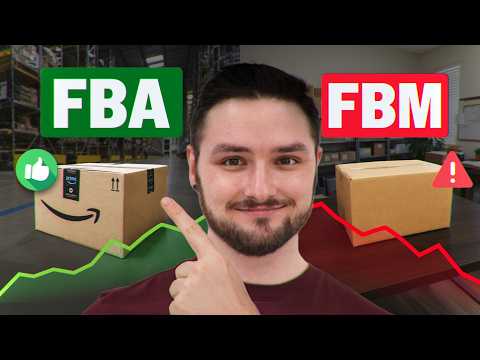
The video argues that FBA (Fulfilled by Amazon) is the better default fulfillment choice for the large majority of Amazon sellers due to ten compounding advantages, while recommending FBM (or a hybrid "dual front" approach) for oversized/bulky, slow-moving, high-value/fragile products, or sellers who already run a large fulfillment network.
Reason 1: The Prime badge gives instant credibility and lifts conversion rates 5-10% versus non-Prime listings; it's obtainable via FBM through Seller Fulfilled Prime (SFP), but SFP is described as very tricky to maintain.
Reason 2: Amazon recently changed the featured offer (buy box) eligibility requirements so that FBA now has a structural advantage over FBM regardless of seller type (brand owner, wholesaler, or reseller).
Reason 3: Amazon handles customer service under FBA, protecting sellers from account health dings tied to order defect rate, negative feedback, A-to-Z claims, and chargeback claims; FBM sellers can pay Amazon for this but at extra cost.
Reason 4: FBA enables fast (1-2 day, sometimes same-day) shipping nationwide because Amazon disperses inventory across its warehouse network, which is cheaper than most brands trying to replicate that coverage themselves.
Reason 5: Multi-channel fulfillment (MCF) lets sellers use their FBA inventory to fulfill orders from Shopify, Walmart, TikTok, and other channels, acting as a full third-party logistics provider from one inventory pool.
Reason 6: FBA (combined with MCF and Amazon Warehousing and Distribution) offers scalability without needing to staff or build a warehouse, including avoiding seasonal Q4 hiring.
Reason 7: FBA shipping is cheaper at scale, roughly $3+ per unit versus $4.50-$8 per unit via UPS/USPS; at 1,000 units/month a $2 per-unit gap equals about a $2,000 monthly profit difference.
Reason 8: Amazon automatically applies the Prime filter on mobile search, so FBA listings get shown by default to the over-70% of buyers shopping on mobile, boosting impression share.
Reason 9: FBA removes logistics obstacles so sellers can focus on product and marketing instead of warehousing/3PL management; the agency states it also handles forecasting for FBA clients.
Reason 10: Most consumers believe they are buying directly from Amazon rather than from the individual seller/brand, and the Prime badge reinforces that trust.
FBM (or reduced FBA) is recommended for oversized/bulky products, since inbound shipping and storage costs (even with AWD) erode margin.
FBM is recommended for slow-moving inventory, since long-term storage fees hurt both cost and account/product standing.
FBM is recommended for high-value, fragile products, since Amazon is described as prone to breaking/losing items and driving higher return rates that are hard to control.
FBM is recommended for sellers who already operate a large existing fulfillment network/3PL, where switching fully to FBA is discouraged.
The overall recommended approach, even for most sellers, is a 'dual front system': keep the majority of inventory in FBA for the Prime badge and conversion boost, while keeping an FBM reserve so the product never goes out of stock when FBA inventory depletes.
FBA (Fulfilled by Amazon) — Amazon's fulfillment service in which sellers send inventory into Amazon's warehouses and Amazon stores, picks, packs, and ships orders under the Prime program. Apply: Send inventory into FBA to gain the Prime badge, buy box advantage, Amazon-handled customer service, faster shipping, multi-channel fulfillment, scalability, and lower per-unit shipping costs at scale, per the video's ten reasons.
FBM (Fulfilled by Merchant) — A fulfillment model where the seller stores, packs, ships, and typically handles customer service for their own orders rather than using Amazon's warehouses. Apply: Stay on FBM for oversized/bulky products, slow-moving inventory, high-value fragile items, or when you already operate a large existing fulfillment network, per the video's stated exceptions.
SFP (Seller Fulfilled Prime) — A program that lets FBM sellers display the Prime badge on their listings while still shipping orders themselves. Apply: The video advises against relying on SFP to obtain the Prime badge, stating it is 'very, very tricky to stay and maintain' and that it would 'not touch SFP' for that purpose.
MCF (Multi-Channel Fulfillment) — An Amazon service, described alongside its supply chain services, that fulfills orders placed on non-Amazon sales channels (Shopify, Walmart, TikTok, etc.) using a seller's existing FBA inventory. Apply: Route orders from external storefronts through MCF so all inventory stays in one location and Amazon functions as the seller's third-party logistics provider across every channel, instead of coordinating a separate 3PL.
AWD (Amazon Warehousing and Distribution) — An Amazon bulk-warehousing and distribution service mentioned as part of Amazon's broader logistics offering alongside FBA and MCF. Apply: Combine AWD with FBA/MCF for added scalability and reduced staffing/warehouse needs, though the video notes it still adds storage cost that can erode margin on large, bulky products.
Buy Box / Featured Offer — The default purchase offer Amazon displays to shoppers, now allocated according to updated featured offer eligibility requirements that the video says favor FBA sellers. Apply: Send inventory to FBA rather than FBM to improve the odds of winning the featured offer/buy box under Amazon's changed eligibility rules, regardless of whether you are a brand owner, wholesaler, or reseller.
Prime badge — The visual marker Amazon places on Prime-eligible listings that signals fast shipping and trustworthiness to buyers, and which is automatically applied as a filter on mobile search. Apply: Obtain the badge via FBA to lift conversion 5-10%, gain automatic visibility to the over-70% of mobile buyers, and tap into the trust that most consumers place in Amazon as the perceived seller.
Dual front system — A hybrid inventory strategy recommended by the speaker in which the majority of stock is placed in FBA while a reserve is kept in FBM. Apply: Keep most inventory in FBA to capture the Prime badge, conversion boost, and ranking benefits, but hold back an FBM reserve so the listing never fully runs out of stock once FBA inventory depletes.
The buy box (featured offer) advantage for FBA is attributed to a recent, specific Amazon policy change to featured offer eligibility requirements that removed prior parity between FBA and FBM sellers.
Amazon auto-applies the Prime search filter on mobile devices, so FBM sellers can lose impression share among the >70% of mobile buyers without an obvious explanation for the drop.
The cost argument is quantified concretely: a $2 per-unit shipping cost gap between FBA and carrier shipping is said to translate into roughly $2,000 in monthly profit difference at 1,000 units sold.
SFP (Seller Fulfilled Prime) is explicitly flagged as a workaround to get the Prime badge while staying FBM, but is called 'very, very tricky to stay and maintain,' with an explicit recommendation not to use it.
The video's actual endpoint recommendation is not pure FBA but a hybrid 'dual front system' — majority inventory in FBA for the conversion/Prime benefits, with an FBM reserve specifically to prevent stockouts once FBA inventory runs out.
Bulky and slow-moving traits are noted to frequently overlap in the same products, compounding Amazon's storage fee penalties and making that combination the clearest case for staying FBM.
«It's instant credibility.»
— 00:30
«Amazon actually just recently changed how featured offer and buy box works.»
— 00:53
«And that is going to be one of those things that eats away at profitability at scale heavily.»
— 06:03
«$2,000 difference in total profit that could be back in your pocket if you utilize something like Amazon FBA.»
— 06:13
«Amazon auto puts the Prime badge on.»
— 07:00
«They think they are buying your product from Amazon.»
— 09:37
«So, that is the number one sin on Amazon.»
— 13:54
Reception
No comments were available to gauge audience reception.
The video is a persuasive, structured checklist strongly favoring FBA (ten stacked reasons) while carving out clear, narrower exceptions for FBM, ultimately steering most viewers toward its house recommendation of a hybrid 'dual front' FBA-majority/FBM-reserve strategy.
14:27