121:15
protein requirements
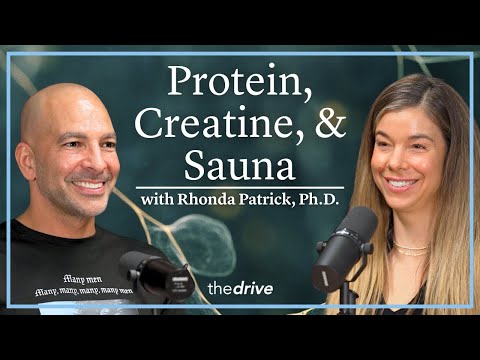
The 0.8 g/kg/day protein RDA is a minimal-deficiency floor, not an optimal target — isotope-tracer research and resistance-training data support a practical range of 1.6-2.2 g/kg/day (especially for older, active, or recomposition-focused people) — and this same evidence-first, dose-response lens is applied to reassess creatine (safe, understudied at brain-relevant doses, most benefit at 5-10 g/day) and sauna use (cardiovascular and dementia risk reduction via heat shock proteins, with an inverted-U temperature-risk curve).
The 0.8 g/kg/day RDA for protein is a minimal-deficiency threshold, not an optimal target, and traces back to flawed nitrogen-balance methodology.
Stable isotope tracer studies put the true minimum protein requirement at ~1.2 g/kg/day, 30-50% above the RDA.
The body has no storage depot for amino acids the way it stores fat or glycogen; skeletal muscle is the functional 'storage tank,' so insufficient intake immediately triggers muscle catabolism.
Anabolic resistance (reduced muscle response to protein) rises with age but is driven mainly by inactivity, not aging itself; resistance training largely restores a young-adult-like anabolic response.
Older adults need roughly double the protein of younger adults to achieve the same muscle-protein-synthesis response, and hitting 1.2 g/kg/day meaningfully reduces frailty risk in older women.
Muscle and strength loss in aging occurs as discrete, non-recoverable step-drops around catabolic crisis events (surgery, falls, illness) rather than as a smooth decline, arguing for banking muscle mass while young (40s-60s).
Protein dose-response on muscle protein synthesis and lean mass saturates around 1.6-2 g/kg/day for most people, with diminishing but nonzero returns up to ~3 g/kg; only elite/endurance athletes benefit from 2-2.2 g/kg.
Because undershooting protein hurts more than overshooting helps, the guests recommend targeting 1.6-2.2 g/kg/day (practically ~2 g/kg) rather than the bare 1.2 g/kg floor.
No human clinical evidence shows harm from high protein intake (up to 2.5 g/kg/day) in people with normal kidney function; renal failure patients are the one group needing restriction.
Body recomposition (simultaneous fat loss + muscle gain) requires especially high protein (2.2-3 g/kg) to prevent catabolism during a caloric deficit.
GLP-1 drugs (e.g., tirzepatide) can now be used safely in most patients if muscle/protein needs are actively managed; steady low-to-moderate dosing (5-7.5 mg) is preferred over rapid escalation and yo-yoing.
Low-dose ('micro-dosed') GLP-1 (2.5 mg) may benefit lean, metabolically dysfunctional patients by improving glucose tolerance without causing weight loss.
Overweight/obese individuals should calculate protein targets from target/lean body weight, not actual body weight.
Caloric restriction and rapamycin are the only two known non-genetic lifespan-extending interventions across model organisms, and both work by downregulating mTOR, but mTOR activation is desirable locally in skeletal muscle even as chronic systemic activation may be harmful.
Rapamycin's dramatic lifespan extension in mice may not translate proportionally to humans, since mice live far below their body-size-predicted ('longevity quotient') lifespan while humans are already near theirs; rapamycin also blunted muscle protein synthesis in human resistance-training studies.
Exercise is framed as 'the most important drug,' with no pharmaceutical yet matching its combined effects; protein's main role is to support the physical activity that drives most of the health benefit.
Creatine is one of the most studied and safest sports supplements; the old 'creatine phosphate is better than monohydrate, load 30 g/day for 2 weeks' belief from 1980s gym culture is outdated, and creatine monohydrate at 5 g/day (no loading) is the modern standard.
Creatine works by regenerating ATP via phosphocreatine, adding 1-2 extra reps in training rather than directly boosting muscle protein synthesis in sedentary people, so strength/muscle gains come from the extra training volume it enables.
Vegetarians/vegans rely entirely on endogenous creatine synthesis (no dietary meat source) and show disproportionately large benefits from supplementation.
Creatine does not damage kidneys; elevated creatinine in supplement users is a measurement artifact, and cystatin C is the more accurate kidney marker in this population.
Brain creatine uptake appears to require a higher dose (~10 g/day) than muscle saturation (5 g/day) because muscle 'greedily' absorbs most of a standard dose first; many null brain-effect studies may simply have been underdosed.
Creatine's brain benefits (processing speed, memory) emerge specifically under stress -- sleep deprivation, psychological/emotional stress, or neurodegenerative disease -- paralleling how it helps muscle specifically under training stress.
A pilot study found high-dose creatine (20 g) improved cognitive function in Alzheimer's patients, framed as part of a broader 'Alzheimer's as an energy crisis' hypothesis addressable years before diagnosis.
Roughly 95% of tested creatine gummy products were found to contain essentially no real creatine; capsules and poorly manufactured formats are also unreliable, so plain monohydrate powder with NSF certification (or Creapure) is recommended.
Regular sauna use (4-7x/week) is associated with a 66% lower dementia/Alzheimer's risk than once-weekly use, and with reduced cardiovascular disease risk, converting the speaker from skeptic to advocate after reviewing 5 years of data.
Sauna's cardiovascular benefit partly mimics moderate aerobic exercise and is dose-dependent on heat shock protein activation (~50% increase over baseline at 163°F/30 min); infrared saunas need roughly double the session length to match dry-sauna cardiovascular effects.
There's an inverted-U risk curve for sauna temperature: benefits plateau around 180°F, while extreme temperatures (200°F+, up to 212°F, seen on social media) are associated with increased dementia risk, prompting both speakers to lower their personal sauna temperatures.
Heat shock proteins induced by sauna use prevent protein misfolding/aggregation and remain active well after the session, with animal studies showing they protect against amyloid-beta aggregation, a proposed mechanism for sauna's dementia-risk reduction.
A single hyperthermia treatment (raising core body temperature ~2°F) produced a six-month antidepressant effect versus sham control in prior research, suggesting a mental-health pathway for heat exposure distinct from its cardiovascular/cognitive effects.
RDA (Recommended Daily Allowance) critique reframe — The government's 0.8 g/kg/day protein RDA, derived from flawed nitrogen-balance studies, functions as a minimal (not optimal) daily allowance that most adults barely meet. Apply: Treat the 0.8 g/kg RDA figure or a product's '% daily value' protein claim as a bare floor to avoid deficiency, not a target to aim for.
Nitrogen balance study (methodological critique) — The classic method for setting the RDA, undermined by variable food nitrogen-to-protein ratios, incomplete urine collection, and non-urinary nitrogen losses. Apply: Discount protein guidelines that trace back only to nitrogen-balance data as likely underestimates.
Stable isotope tracer method (L-13C phenylalanine) — A more accurate alternative to nitrogen-balance studies for measuring protein requirements, using carbon-13-labeled phenylalanine to track amino acid oxidation and derive a true minimum intake (~1.2 g/kg/day). Apply: Cite isotope-tracer-derived intakes (1.2 g/kg minimum) rather than RDA nitrogen-balance figures when setting a personal protein floor.
Four Horsemen framework — Attia's model naming cardiovascular/cerebrovascular disease, cancer, neurodegenerative disease, and metabolic disease as the primary drivers of mortality, with frailty positioned as a separate quality-of-life risk. Apply: Use the framework to separate lifespan-limiting disease risk from healthspan/frailty risk when prioritizing interventions.
Leucine transporter / anabolic resistance mechanism — Muscle's sensitivity to leucine (the primary trigger of muscle protein synthesis) declines with inactivity, requiring larger protein doses to achieve the same synthetic response. Apply: Pair protein intake with resistance training, since training restores leucine-transporter sensitivity and largely negates age-related anabolic resistance.
mTOR (mechanistic target of rapamycin) pathway — A nutrient/growth-signaling pathway activated by leucine and mechanical load in skeletal muscle; chronic systemic activation (vs. localized muscle activation) is implicated in aging and disease. Apply: Aim to activate mTOR locally via exercise plus adequate leucine/protein intake rather than seeking constant systemic activation or suppression.
Body recomposition protocol — A combined resistance-training + caloric-deficit + high-protein (2.2-3 g/kg) approach intended to lose fat and gain muscle simultaneously without net catabolism. Apply: When cutting calories while training, push protein to 2.2-3 g/kg and stay above the 1.6 g/kg floor to prevent muscle loss.
Caloric-deficit / amino-acid-excess technique — Using low-calorie liquid whey protein to hit high amino acid intake while running a caloric deficit, including within an intermittent-fasting structure. Apply: Add whey shakes outside the fasting window to hit protein targets during a cut, since they add few calories relative to their protein content.
APOB dose-response curve analogy — A comparison to cardiovascular risk management (APOB targets ranging from ~30 mg/dL for high-risk patients to ~60 mg/dL population-normal) used to illustrate that 'optimal' protein intake is context-dependent, not a single fixed number. Apply: Set personal protein targets based on individual risk/goal context rather than a single population-average guideline.
Asymmetric target-range buffering — A dosing strategy that sets the daily protein target above the true minimum (e.g., aim for 2 g/kg, floor at 1.6 g/kg) because falling short causes more harm than exceeding it causes benefit. Apply: Pick a protein target meaningfully above your true floor so that an off day still clears the minimum.
GLP-1 (tirzepatide) graduated dosing protocol — A conservative dosing approach for GLP-1 receptor agonists that favors a steady low-to-moderate dose (5-7.5 mg) over rapid escalation, to avoid the weight/muscle 'yo-yo' effect of cycling on and off. Apply: Titrate GLP-1 dosing slowly and hold at the lowest effective dose rather than pushing to the maximum (12.5-15 mg) for marginal extra effect.
GLP-1 micro-dosing for metabolic dysfunction — Using a low GLP-1 dose (2.5 mg) in normal-weight/lean patients with metabolic dysfunction (e.g., diabetes) to improve insulin sensitivity/OGTT results without inducing weight loss. Apply: Consider low-dose GLP-1 as a metabolic (not weight-loss) tool in lean patients with dysglycemia, paired with protein-forward nutrition.
DEXA scan monitoring — Dual-energy X-ray absorptiometry used pre/post GLP-1 treatment to track lean body mass loss alongside fat loss. Apply: Get a DEXA scan before and during GLP-1 therapy to catch disproportionate lean-mass loss early.
OGTT (oral glucose tolerance test) — A test used to track normalization of glucose metabolism in lean, metabolically dysfunctional patients on micro-dose GLP-1. Apply: Use serial OGTTs to monitor metabolic response when using GLP-1 therapy off-label for glycemic control.
Target-weight (not actual-weight) protein calculation — For overweight/obese individuals, protein needs should be calculated from target/lean body weight rather than current total body weight, to avoid overestimating requirements. Apply: If overweight, compute your g/kg protein target using your goal weight or lean mass, not your current scale weight.
Caloric restriction & rapamycin as mTOR-downregulating geroprotectors — The only two non-genetic interventions shown to extend lifespan across yeast, worms, flies, and mammals, both acting by downregulating mTOR. Apply: Frame caloric restriction and rapamycin as the two evidence-backed systemic mTOR-suppression levers, contrasted with local muscle mTOR activation via training.
Longevity quotient framework — A model (attributed to Eric Verden) plotting expected lifespan against body size across species, used to argue mice's rapamycin benefit reflects living far below their body-size-predicted lifespan, a gap humans (near their ~80-year predicted ceiling) may not share. Apply: Be skeptical of directly extrapolating mouse rapamycin lifespan-extension data to expected human benefit, given the differing starting gap to each species' longevity quotient.
Creatine loading protocol (historical) vs. daily maintenance dosing — The old 1980s-era practice of loading 20-30 g/day for ~2 weeks to rapidly saturate muscle creatine, now considered unnecessary for most users; 5 g/day saturates muscle within 3 weeks to a month with less GI distress. Apply: Skip the loading phase unless preparing for imminent competition; take a flat 5 g/day (or ~10 g split dose to also target brain saturation) instead.
Creatine monohydrate vs. creatine phosphate identity check — A correction of the long-standing supplement-store claim that 'creatine phosphate' is a superior form; creatine monohydrate is the well-studied, effective, and safe form. Apply: Buy creatine monohydrate specifically, disregarding 'creatine phosphate' or other proprietary-form marketing claims.
NSF certification screening — A third-party certification standard used to verify a creatine (or other supplement) product is free of heavy-metal (e.g., lead) contamination. Apply: Check for NSF certification (or an equivalent brand like Creapure) before buying creatine, and avoid gummy formulations, which testing found ~95% lacking real creatine content.
Cystatin C vs. creatinine for kidney function assessment — Cystatin C is a GFR marker unaffected by creatine supplementation, unlike creatinine, which rises artifactually in creatine users and can be mistaken for kidney impairment. Apply: If supplementing with creatine, ask your physician to assess kidney function via cystatin C rather than (or alongside) creatinine to avoid a false-positive impairment reading.
Pediatric/adolescent creatine dosing (weight-based) — A body-weight-scaled creatine dose (~0.1 g/kg) used for younger users, illustrated with the speaker's own children (2.5 g and 5 g doses). Apply: Scale creatine dose to body weight (~0.1 g/kg) for adolescents rather than using flat adult dosing.
Dry sauna hormetic-stress protocol — A heat-exposure protocol (163-190°F for 20-30 minutes) shown to raise heat shock proteins ~50% over baseline and produce cardiovascular adaptations resembling moderate aerobic exercise. Apply: Use a dry sauna in the ~180°F range for 20-30 minutes as a calibrated hormetic stressor rather than pushing to extreme (200°F+) temperatures, which show no added benefit and a possible dementia-risk signal.
Infrared sauna dose equivalence adjustment — Because infrared saunas raise heart rate and core temperature more slowly than dry saunas, roughly double the exposure duration (~40 min vs. 20 min) is needed to approximate the same cardiovascular effect. Apply: If using an infrared sauna instead of a dry sauna, roughly double session length to match the cardiovascular stimulus of a standard dry-sauna protocol.
Heat shock protein (HSP) response — A cellular stress-response mechanism triggered by heat exposure that prevents protein misfolding/aggregation and remains active well after the sauna session ends, implicated in protective effects against amyloid-beta aggregation in animal models. Apply: Treat sauna-induced HSP activation as the proposed mechanism linking sauna use to reduced dementia/Alzheimer's risk, motivating regular (4-7x/week) rather than occasional use.
Hyperthermia treatment for depression — A controlled whole-body heating protocol (raising core temperature ~2°F), developed by Charles Raison, shown in one study to produce a six-month antidepressant effect after a single treatment versus sham control. Apply: Reference this as evidence for heat exposure (sauna or hyperthermia chamber) as a candidate mental-health intervention, distinct from its cardiovascular/dementia effects.
The 'smooth decline' chart of age-related muscle loss is described as a population-level averaging artifact; at the individual level, loss happens in discrete, non-recoverable steps tied to specific catabolic events (surgery, flu, immobilization), reframing muscle maintenance as a banking problem to solve while young rather than a gradual-decline problem to manage later.
The 2 g/kg protein target is explicitly built as a deliberate buffer against real-world nonadherence: aiming high means a bad day still clears the 1.6 g/kg floor, whereas aiming at the floor itself means a bad day drops below it with no next-day compensation, since the downside is framed as asymmetric to the upside.
The APOB/cardiovascular-risk analogy is used to argue there is no single universally 'optimal' protein number; the right target is context-dependent (post-disease vs. healthy, athlete vs. sedentary) the same way LDL/APOB targets shift by cardiovascular risk profile.
Mouse-based mTOR findings are repeatedly flagged as potentially non-translatable to humans, including a specific study where a 25 g-equivalent protein dose activated macrophage mTOR and was framed as protein causing atherosclerosis; the speakers argue this reflects systemic vs. muscle-directed leucine delivery rather than protein intake per se.
Injection site for GLP-1 drugs (abdomen vs. limb) is floated as an underappreciated variable in appetite suppression, possibly via vagal tone, offered as an anecdotal, mechanism-first observation rather than an established finding.
Many negative studies on creatine's cognitive/brain effects may be artifacts of underdosing: muscle tissue 'greedily' absorbs a standard 5 g dose before it reaches the brain, so studies using 5 g may show no cognitive effect while the same compound at 10 g does.
Creatine's brain benefit is described as stress-conditional (sleep deprivation, psychological stress, neurodegeneration) rather than constitutive, mirroring how it only aids muscle during training stress, not at rest.
Wearing a sauna hat is described as counterintuitively net-protective at high temperatures despite reducing heat dissipation from the head, raised in the discussion of extreme-temperature risk data.
The 'exercise in a pill' project is characterized as probably requiring roughly 500 separate molecules to replicate exercise's effects, implying no single drug is likely to substitute for it.
Elite athletes (NBA, MLB) routinely consume ≥2 g/kg protein and are cited as among the longest-lived populations, offered as real-world counter-evidence against the claim that high protein intake is harmful.
«Hey everyone, welcome to the Drive Podcast. I'm your host, Peter Aia.»
— 00:00
«the RDA has been underestimated because of those reasons»
— 03:50
«we don't store amino acids like we store fatty acids as triglycerides or we store glucose as glycogen, right? The major source of our amino acid storage tank, so to speak, is our muscle, skeletal muscle tissue.»
— 04:43
«the leg that was uncasted, perfectly normal, the other one significant anabolic resistance. So to me, that's the clearest demonstration that inactivity is the main culprit.»
— 13:19
«when you are young, and young is 40, 50, even 60, you have to build up as much physiologic headroom as possible…the rainy day is coming. It's not a question of if. It's simply a question of when»
— 23:25
«if you have like a wet washcloth and you squeeze all you squeeze it to get all the water out, you know, like most of that water is coming out at 1.6 g per kilogram body weight. But you can keep squeezing a little and you're getting some water out. It's just sort of marginal.»
— 28:33
«every day you're below, the downside is much greater than the upside of being above…all the days you're above are not making up for all the days you're below»
— 34:29
«this is the difference between people who take care of people in the real world and bozos who write on Substack who don't know the first thing about clinical medicine»
— 35:10
«Show me the data that eating 2.5 gram of protein per kilogram per day is even remotely harmful. I'm still waiting for it.»
— 37:26
«So if we accomplish nothing else that that's the single most important take-home message here... just knowing that 0.8 8 g per kilogram body weight per day is just it's not enough at all.»
— 38:51
«I today think that virtually anybody can use these drugs safely but and by safely I I don't just mean in the obvious sense of the word. I mean, safely for long-term muscle health as well, right?»
— 46:27
«Really if you're someone that's overweight or obese, you shouldn't be calculating it based on your actual weight because your protein require it'll be way too high. It's more like your target weight, right?»
— 54:20
«You want mTor active in your skeletal muscle. You want it active in your skeletal muscle. You don't necessarily always want it active systemically.»
— 56:50
«People are not mice, right?»
— 59:21
«exercise is the most important drug. I just don't I'm just not aware of a drug in quotes that is that is better than exercise.»
— 71:36
«If you aim for two on the day you fall short, you'll still be at 1.6. If you aim for 1.6, on the day you fall short, you'll be 1.2. and that 1.2 won't be made up for on the next day because the downside is asymmetric compared to the upside.»
— 74:06
«We would hang out at supplement stores. Like we'd literally go in and the supplement stores always had some big bro in baggy pants that tapered down to his feet and he was barely wearing a shirt and he was yolked and he was explaining to us... there's creatine monohydrate and then there's like creatine phosphate and at the time everyone said creatine phosphate is better and you have to load 30 grams a day for 2 weeks...»
— 75:38
«I don't know that there's any other sports supplement out there that's as safe as creatine. I don't think there is.»
— 77:12
«the muscles are greedy as hell»
— 86:07
«20% of our total caloric intake goes to an organ that weighs less than 2% of your body weight. It is the most insane statistic of the human body.»
— 89:03
«creatine for the brain is the most interesting aspect of this area of research right now»
— 94:07
«there was essentially none in 95% of them»
— 97:09
«I'm now in a place where I actually view sauna as an intervention that can help an individual reduce their risk.»
— 102:43
«infrared saunas, if you want it to mimic the cardiovascular exercise response, you might have to double that.»
— 107:36
«single treatment... an antid-depressant effect that lasted six months compared to a sham control»
— 111:50
«The heat shock proteins, what they do is they prevent proteins from misfolding and forming aggregates»
— 113:21
«there's no evidence you're getting added benefit and if anything there's potential benefit risk»
— 117:13
«Peter is someone that I've always been able to trust for being rigorous, right? And really like like you said, if something changes, then you change.»
— 120:16
Reception
Positive reception with engaged viewers discussing practical implementation and validating the science, though some criticize the host's interviewing style.
The episode is a dense, citation-heavy evidence review across three linked topics -- protein dosing, creatine, and sauna use -- grounded in named studies and the hosts' own clinical/research experience, with uncertainty explicitly flagged where evidence is thinner (brain-dose creatine studies, the sauna-hyperthermia-depression link, mouse-to-human translation of mTOR/rapamycin data).
121:15