16:01
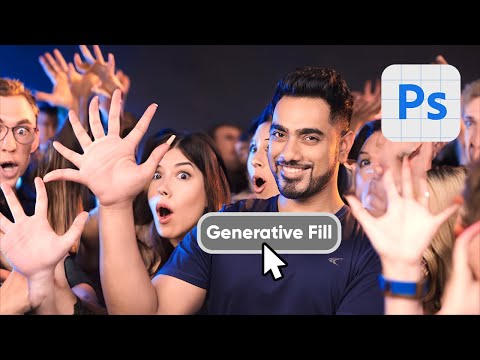
Generative Fill
The video argues that Adobe Photoshop's Generative Fill will not replace creative professionals "yet" because of concrete, demonstrable limitations — a hard resolution cap, lack of precision and symmetry, content-guideline blocks plus unresolved legal/licensing questions, and unreliable handling of fine details like hands, feet, and faces — all of which still require traditional Photoshop skills to fix or work around, while acknowledging the technology will keep improving over time.
Reason 1 (resolution): any single Generative Fill generation is capped at 1024 pixels on the longest side, causing visible quality degradation ('absolute degradation in quality and resolution') when composited into full-resolution images, which the presenter says makes it unusable for commercial work.
A proposed workaround — generating patch-by-patch at fixed 1024x1024 selections instead of all at once — introduces three new problems: it is extremely time-consuming (an example needs ~14-15 blocks with 3+ generation attempts each), it creates continuation/alignment mismatches between adjacent patches, and the actual generated area is smaller than the selected 1024x1024 area, so maximizing resolution requires even smaller, even more time-consuming generations.
Reason 2 (precision): a hand-made shadow built with the pen tool, brushes, and partial transparency (to preserve dress translucency) is shown against an AI-generated shadow for the same composite; the AI version is called unusable, needing 'hours' of cleanup, versus creating it from scratch being 'much easier.'
Symmetry is raised as a related weakness: generating car wheels via Generative Fill looks convincing at a glance but on zoom shows spokes of inconsistent thickness and a non-perfect circle — described as 'no sense of symmetry' — so symmetric/aligned elements are recommended to come from compositing real source photos with masking, selection, and blend modes instead.
Sponsor segment: the video promotes the 'PiXimperfect Compositing Panel' (the video's sponsor, described as Adobe-approved) as a traditional-technique tool for importing/stacking elements, auto background removal, one-click alignment, subject-background color matching, shadow extraction, halo removal, hair masking brushes, textures/overlays, and color-grading presets.
Reason 3 (content guidelines / legal gray areas): an attempt to extend an image of a fully covered, non-explicit subject in a sari is flagged and removed for violating 'user guidelines'; typing a prompt like 'sari' works around the block but the presenter says the result 'lacks Precision,' citing a jewelry artifact resembling 'a diamond on the forehead.'
Results are described as unpredictable ('like placing a bet on the roulette table') — a shadow generation looks fine zoomed out but is 'messed up' in specific areas on zoom; the presenter shows five separate generations of the same shadow, each good in some spots and bad in others, requiring manual combination/masking plus Remove-tool cleanup to reach an acceptable final result — work the presenter says 'your client will not do.'
Unresolved legal/business questions raised (presenter explicitly says 'I'm not a lawyer'): who owns rights to Generative Fill output; the tool was in beta and per Adobe's website could not be used commercially at the time; it is trained on Adobe Stock, raising an open question of how stock photographers whose work is drawn on would be compensated; and what license tier (standard/enhanced/extended) generated content would carry — leading the presenter to say he would have doubts using it for major commercial placements like billboards for Amazon or Mercedes-Benz.
Generative Fill is described as a strong background-replacement tool specifically when the new background is blurred (resolution matters less), giving good lighting and reflection results in a beach-background example — but edges need major cleanup (an extra, erroneously generated finger is shown), requiring traditional selection, masking, and Clone Stamp tool work to fix.
Bonus Reason 6 (details): Generative Fill is specifically unreliable on hands, feet, and faces ('it just lets the dogs out') — examples include AI-generated 'alien feet,' a background figure's hand/arm turning out with an unclear number of fingers after an unrelated object was removed nearby, and distorted faces when generating a person ('Man') into an image.
The video contrasts current Generative Fill quality with Midjourney's rapid version-over-version improvement (v1 through v5/5.1), showing AI images by 'Julie Weiland' (credited as an AI expert and graphic designer) described as photorealistic ('you cannot tell that this is not a photo') — but notes she still processes/finishes these images in Photoshop using professional skill.
Overall framing: the presenter advises combining traditional Photoshop technique (masking, selections, blend modes, Clone Stamp, pen tool) with new AI tools rather than relying on AI alone, framing this blended skill set as what keeps a creative professional 'one step ahead' and irreplaceable, 'whether it's the present or the future.'
The patch-by-patch resolution workaround is presented as a case where a naive fix trades one problem (low resolution) for three new ones (time cost, cross-patch continuation errors, and generated area being smaller than the selection) — an implicit systems-level point that workarounds aren't free.
The content-guideline block example is framed by the presenter as inconsistent policy rather than coherent moderation: a fully covered, non-explicit image is flagged and removed, while the presenter explicitly says 'I don't know what kind of guidelines we violated,' positioning the moderation behavior itself as unpredictable rather than a stable limitation.
The legal/licensing section reframes the 'AI replacing creatives' fear as partly a business/legal-risk problem for whoever commissions commercial work (unclear rights ownership, uncompensated stock-photographer training data, undefined license tier) rather than purely a skill gap — this is why the presenter says he wouldn't risk it for billboard-scale client work.
Recombining and cherry-picking across multiple AI generations (masking together the 'good' region of generation 1 with the 'good' region of generation 3, etc.) is itself framed as a skilled, human-driven compositing workflow — implying AI doesn't eliminate the compositing skill requirement, it just changes the raw material a compositor works from.
Symmetry failure is treated as a distinct technical blind spot separate from photographic realism — the wheel example looks convincing overall but fails specifically on geometric consistency (spoke thickness, circularity), suggesting structural/geometric precision is a different axis of weakness than visual plausibility.
The video closes by treating the video's own title condition ('...Yet') as literal and ongoing: it explicitly predicts Generative Fill 'will only get better with time' (pointing to Midjourney's version history as precedent) and frames the professional's job as continuously staying ahead of that improvement curve rather than resisting the tool.
«now it's pretty evident that a lot of us are concerned so here's five solid reasons why generator film will not replace you as a creative professional yet»
— 00:21
«this is a big one the resolution of any generation right now is limited to 1024 pixels on the longest side»
— 00:31
«this is an absolute degradation in quality and resolution right and obviously this is not something you can use for commercial work»
— 00:58
«so as you can tell there is no sense of symmetry this is a good result there's no denying the fact but no sense of symmetry»
— 05:47
«the generated images were removed because they violate user guidelines I don't know what kind of guidelines we violated»
— 07:55
«at the moment it's like placing a bet on the roulette table because you never know how good or bad the result you're gonna get»
— 08:35
«it's not all automatic AI stuff now I'm not a lawyer but we have questions the answers to which are still unclear»
— 10:10
«would you risk using generative fill for major commercial projects let's say for Billboards for Amazon or Mercedes-Benz I have my doubts»
— 11:01
«however with generator fill whenever we are tackling details it just lets the dogs out right in here where it was supposed to create some feed it created alien feet instead»
— 13:14
«in all of the cases whether it's the present or the future as long as you stay one step ahead of the game no one can replace you»
— 14:56
Reception
Audience appreciates the content quality and humor but remains skeptical about the core claim, with widespread concern that AI will eventually displace creative professionals despite current limitations.
The video's own conclusion is that Generative Fill remains a supplementary tool rather than a replacement, undercut by resolution caps, weak precision/symmetry, content-guideline unpredictability, unresolved legal/licensing questions, and poor detail handling — but it explicitly frames this as a temporary state ('yet') that will erode as the tool matures, so the real recommendation is to keep stacking traditional skills alongside AI rather than rely on either alone.
16:01