07:37
charisma
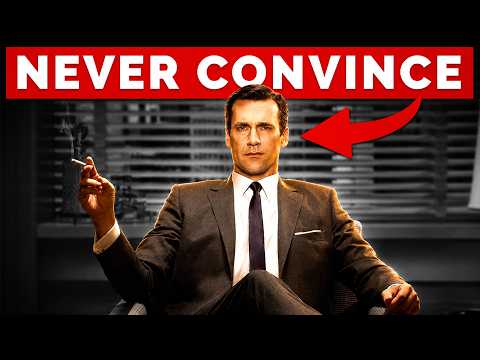
Analyzing a Mad Men scene where Don Draper stays composed while his company is sold out from under him, the video argues that charisma comes from never needing to convince anyone of anything — you slow down, accept the other person's actual power to choose, name your own choice, and invite them into a solution with no pressure, which is what keeps you in control of yourself during high-stakes conflict.
The setup: Don's ad agency is being sold, and Duck (the incoming president) plans to subordinate creative to "financial maturity," downgrading Don's department to squeeze profits.
The old owners push back ("I don't think I heard the word client once"), so Duck doubles down and casually insults Don's entire career: "There's no reason for us to be tied to creative's fantasies of persuasion."
The presenter says this is where "most people's charisma goes out the door" — they reflexively defend themselves, which only weakens their position.
Don instead stays silent and is even reluctant to speak when asked for his opinion, then delivers: "I think it sounds like a great agency. I just don't think I'll be a part of it."
This is framed as the embodiment of "the fourth charismatic principle": charisma doesn't convince, and you don't have to convince anyone of anything.
Trying to convince someone is described as "manipulating yourself" — you either squeeze into whatever space the other person has for you, or try to change them to accept you, which is still just chasing them; that convincing energy reads as neediness, and people don't want to connect with someone who has given away their power like that (said to hold true in sales, romance, and friendship).
Duck himself is offered as the negative example: he tries to convince the owners by insulting Don further ("artistic temperament"), then tries to strong-arm Don by threatening his job: "you can either honor your contract or walk out that door with nothing and start selling insurance."
Don's reply, "I don't have a contract," is glossed by the presenter as meaning "Your threats don't bother me because you don't own me."
Three habits are pulled out of Don's behavior: (1) slow down your response when you feel under fire — you don't get points for defending yourself quickly, but you can lose them for being hyper-reactive; (2) fully accept the other person's actual choice and then name your own choice in response, e.g. "I hear you. If that's the case, I'm going to ___" rather than "You can't do that" or "I've been so valuable"; (3) invite the other person to a solution that works for you with no pressure, naming what you're aimed at and letting them decide — as in Don's line, "I can't see as far into the future as Duck, but if the world is still here on Monday, we can talk."
The presenter gives a personal anecdote: he wanted to relocate from Washington D.C. to New York City, was told analysts couldn't work remotely, and instead of arguing he expressed gratitude, offered to stay on a month or more and make trips back and forth, then stated his need and date plainly — resulting in the president feeling unattacked, a 15-minute conversation, and an eventual remote arrangement with a raise by switching him from analyst to outside contractor.
Clarification: not convincing doesn't mean withdrawing from conflict or never selling anything to anyone — Don still has to be effective at his job, and the presenter still got his remote deal. It means not getting hung up on one company, one client, or one date; you tell the truth as you see it and give the other person space to freely decide.
Don is shown doing this forcefully at times (a monologue ending "And I won't stop until you get all of it... Thank you for your time.") without crossing into convincing, since he never insists the other person agree with him.
The stated mantra is to "live invitationally": "Hey, here's what I'm selling or here's what I'm offering or here's what I'm about. Interested? Great. If not, all good."
Duck's failure to embody this — trying to convince rather than invite — is presented as costing him the job he already had, illustrated by his own boss cutting him off ("Let him go. Let him throw his tantrum... Duck, would you excuse us for a minute?").
Closing recap of the process: when you feel the urge to convince someone, slow down, accept that they have their choice, let them know yours, state how you'd be open to collaborating (if at all), and give them space to make their own decision.
The presenter acknowledges the gap between knowing this and feeling it in intense moments (a boss denying a promotion, a client choosing someone else, a date not texting back) — he says he's had to work at it for years and can still feel the convincing urge rush back.
The video ends with a pitch for Charisma University, including a student testimonial about taking control and feeling more comfortable with honest self-expression, and notes a 60-day money-back guarantee.
The Fourth Charismatic Principle: Charisma Doesn't Convince — The video's core claim that genuine charisma never requires convincing anyone of anything, since trying to convince someone is 'manipulating yourself' and radiates neediness that pushes people away. Apply: Notice the default urge to convince (in a job, relationship, or sale) and drop the urge to persuade rather than acting on it, as Don does by simply stating he won't be part of the new agency instead of arguing his case.
Habit 1: Slow down your response when under fire — Pausing before responding to an attack or challenge instead of defending yourself immediately, since quick defense earns no points but hyper-reactivity can cost you. Apply: When insulted or challenged, delay your reply — mirrored by Don staying silent and being reluctant to speak even when directly asked for his opinion before Duck's insult.
Habit 2: Accept their choice, then name your choice — Fully accepting the other person's actual power to decide without arguing against it, then stating your own response in the form 'I hear you. If that's the case, I'm going to ___,' instead of protests like 'You can't do that' or 'I've been so valuable.'. Apply: Respond to a decision you dislike by naming what you will do in light of it rather than contesting the decision itself — as Don does with 'I think it sounds like a great agency. I just don't think I'll be a part of it.'
Habit 3: Invite the other person to a solution, with no pressure — Naming what you're aimed at and letting the other person freely decide, without insisting they agree with you. Apply: State your terms or offer once and leave room for the other party to choose — as in Don's line 'if the world is still here on Monday, we can talk,' or the presenter's own line to his boss naming his move date while offering a bridge period.
Living Invitationally (mantra) — A stated personal mantra for framing any offer, sale, or opinion as an invitation rather than a pitch you're trying to win. Apply: Frame what you're offering as 'Here's what I'm selling/offering/about. Interested? Great. If not, all good,' rather than pushing to convince the other person to say yes.
The video doesn't leave 'don't convince' as an abstract mindset — it operationalizes it into a repeatable three-step sequence (slow down → accept their choice and name yours → invite without pressure), giving the viewer a script rather than just a feeling to aim for.
Duck functions as a live negative example inside the same clip used for the positive lesson: his insult-then-threaten escalation is presented as the very neediness/convincing energy the video warns against, so success and failure are shown side by side in one scene rather than in separate examples.
The presenter's own negotiation anecdote shows the framework outperforming the original ask: by not arguing for the move and instead stating gratitude, a bridging offer, and a firm date, he ended up with a better outcome (a raise via reclassification to contractor) than the remote work he'd originally requested.
The video is explicit that 'living invitationally' isn't the same as passivity — Don is shown pushing forcefully in a separate scene without breaking the rule, because the line drawn is not intensity of delivery but whether you insist the other person agree with you.
«Well, Bert, when the economy is good, people buy things. And when it's bad, they don't. There's no reason for us to be tied to creative's fantasies of persuasion.»
— 00:42
«I think it sounds like a great agency. I just don't think I'll be a part of it.»
— 01:12
«charisma doesn't convince. And you don't have to convince anyone of anything.»
— 01:29
«And it never actually works because that convincing energy is neediness.»
— 01:57
«Don, you can either honor your contract or walk out that door with nothing and start selling insurance.»
— 02:32
«I don't have a contract.»
— 02:39
«I can't see as far into the future as Duck, but if the world is still here on Monday, we can talk.»
— 03:55
«Totally respect that. Thank you so much for how awesome you guys have been.»
— 04:27
«You're happy with your agency. You're not happy with anything. You don't want most of it. You want all of it. And I won't stop until you get all of it.»
— 05:34
«Hey, here's what I'm selling or here's what I'm offering or here's what I'm about. Interested? Great. If not, all good.»
— 05:44
Reception
Audience appreciates the channel but remains skeptical that the video's charisma tactics translate to real life outside exceptional circumstances.
The video is a tightly constructed case-study lesson: one Mad Men scene is walked through beat by beat, distilled into a named principle and a three-habit framework, reinforced with a real-world anecdote, then closed with a course pitch — a standard Charisma on Command example-to-framework-to-CTA structure.
07:37