AI marketing tools
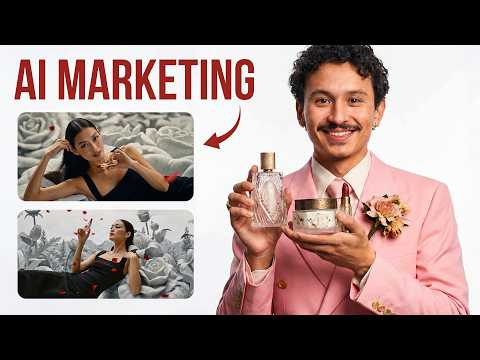
Higgsfield's Marketing Studio, paired with GPT Image 2.0, lets one person build an entire beauty brand from scratch — logo, product line, brand kit, static ads, and cinematic-quality commercial videos — in about an hour and without a designer, agency, or production budget.
Beauty marketing is saturated, and a brand with no history can win fast off one viral video rather than budget or authenticity, with AI accelerating that dynamic.
By 2026, large brands aren't just testing AI, it's already inside their production pipeline, and work that used to require shoots, agencies, and full crews can now be done on a laptop.
The workflow starts with foundation first: a fictional brand ('Higgs') gets its positioning, visual direction, and identity nailed down before any content is produced, using short 'rough direction' prompts rather than long detailed ones.
A logo, a three-item product collection (perfume, lip balm, cream), and a brand kit (colors, fonts, logo variations, brand voice/values/tagline) are generated in GPT Image 2.0 by attaching prior assets as references so later outputs stay visually consistent.
The brand kit becomes the reusable foundation for posters, billboards, and every later ad, keeping product shape, logo, and domain text consistent across formats.
UGC-style video is presented as one of the highest-converting formats for beauty brands because it mimics a friend's personal recommendation rather than reading as an ad.
Marketing Studio's hooks (Epic fail, Product crush, Spicy, Random object mic) and settings (rooftop, volcano, airplane wing) can be mixed with different avatars to produce distinct ad variants and target different audiences from the same product.
Hyper Motion is positioned as the format for luxury-brand billboard/CGI-quality cinematic shots that normally require a director, motion team, and weeks of post-production, delivered instead as a ready preset.
The Wildcard preset turns a character (avatar) plus a short prompt into a 'professional commercial,' while the TV spot preset is called out as the single best mode for producing expensive-looking broadcast-style commercials, including narrative ads combining two avatars and a custom location.
The presenter frames the entire method as a repeatable recipe: character + location + a short prompt + the right preset, claiming a full brand build from blank page to broadcast-quality commercial took about an hour.
GPT Image 2.0 — The image-generation model selectable inside Higgsfield used in the video to create the brand logo, product collection, brand kit layout, and static campaign visuals like posters and billboards. Apply: Select GPT Image 2.0, write a short rough-direction prompt rather than a long detailed one, attach prior assets (logo, product images) as references to keep outputs consistent, and set resolution/aspect ratio and number of versions before generating.
Brand Kit — A single generated reference sheet — created by prompting GPT Image 2.0 with the logo and product line attached — that lays out color palette, typography, logo variations, brand elements, voice, values, and tagline. Apply: Attach the logo and generated product line as reference images, prompt for the desired mood and colors, and generate the brand kit once, then attach that brand kit as a reference for later ads and banners to keep them visually consistent.
UGC (User-Generated Content) format — A Marketing Studio ad format built to mimic a real person filming themselves on an iPhone recommending a product, described as one of the highest-converting formats for beauty brands. Apply: Pick an avatar, upload the product, write a short setting prompt (e.g., 'a cozy home setting'), optionally add a hook, set aspect ratio to 9 by 16, quality to 1080p and duration to 15 seconds, then generate.
Hooks (Epic Fail, Product Crush, Spicy, Random Object Mic) — Preset attention-grab templates inside Marketing Studio's UGC tool — named Epic fail, Product crush, Spicy, and Random object mic — designed to hook viewers in the first seconds of an ad. Apply: When generating a UGC ad, select a hook option (e.g., Random object mic) alongside the avatar and setting to make the same product read as unexpected or entertaining rather than a standard ad.
Hyper Motion — A Marketing Studio preset for luxury-brand-style, billboard/CGI-quality cinematic product shots, described as normally requiring a director, motion team, and weeks of post-production. Apply: Pick a product, optionally attach a custom-made location as a second input, write a short cinematic movement/action prompt (e.g., 'flowers burst from desert sand, petals open to reveal the lip balm, camera pulls back'), and generate.
Soul Cinema (location creation) — A tool referenced in the video for creating custom reusable location/backdrop assets (e.g., a desert scene, a train station) from a short prompt. Apply: Create a location in Soul Cinema, then attach it as an input alongside the product or avatar when generating a Hyper Motion or TV spot ad, so the same custom set can be reused across multiple product videos, or swapped for a real store as backdrop.
Wildcard preset — A Marketing Studio commercial-video preset described as turning 'craziest ideas' into a professional commercial using a character (avatar) plus product as inputs. Apply: Pick or create a custom avatar as the subject, choose the product, write a short descriptive prompt (e.g., 'surreal luxury fragrance ad, warm sand tones, lilac sky, cinematic and slightly uncanny luxury aesthetics'), and generate.
TV spot preset — The Marketing Studio commercial preset the presenter singles out as best for producing 'a million-dollar broadcast campaign' look rather than a social post, combining a custom avatar (or two combined avatars) with a location. Apply: Create a custom avatar (attach a second avatar as a reference image to combine two characters in one generation), attach a created location, write a short prompt (as few as five words), set 16 by 9 aspect ratio, 15-second duration and 1080p quality, then generate.
Custom avatar creation — A Marketing Studio feature for generating a custom character/persona from a short text prompt, used as the on-camera subject across UGC, Hyper Motion, Wildcard, and TV spot ads. Apply: Click 'create avatar' and describe the character briefly (age, ethnicity, hair, outfit matched to brand colors), generate, and reuse the resulting avatar across different ad formats and hooks.
The video explicitly recommends prompting with only a rough creative direction rather than a fully pre-visualized image, framing the model's ability to 'fill in the gaps' as a deliberate prompting strategy, not just a capability.
Consistency across a brand's assets is achieved mechanically: each new generation (products, brand kit, posters, billboards) attaches the previously generated asset (logo, product line, brand kit) as a reference image rather than relying on manually re-describing the style each time.
A custom 'location' asset, once created, is reused as a backdrop across multiple separate product ads (perfume, lip balm, cream) to build a coherent campaign 'set' cheaply, and the video suggests the same mechanism could take a real store as the backdrop input.
Swapping only the avatar, hook, and setting while keeping the same product and script structure is shown to retarget an identical product for different audiences, demonstrated by contrasting a young-adult hand-cream UGC ad with a '60-year-old woman' avatar version using a 'random object mic' hook.
Since Marketing Studio doesn't support two avatars natively in one slot, the presenter works around this by designating one avatar as primary and attaching the second avatar as a reference image to combine two characters into a single generation.
Cost is used as the explicit differentiator: a TV-spot-style commercial the presenter says 'would easily cost you thousands in production' (model, setting, VFX) is claimed to have been produced in-tool for 'nine bucks.'
The most reduced version of the workflow described is 'character, location, five-word prompt, TV spot preset' — the presenter treats prompt length as inversely related to output quality once the character and location assets already exist.
«Beauty marketing is one of the most saturated spaces out there.»
— 00:27
«In 2026, even the giants aren't testing AI anymore. It's already in their production pipeline.»
— 00:41
«And what used to cost a fortune, shoots, agencies, full crews, anyone can do now in their laptop.»
— 00:48
«You don't need a paragraph, just a clear direction is enough.»
— 03:25
«This is the foundation everything else will sit on.»
— 05:55
«Okay, I finally got it.»
— 08:28
«Okay, rude. But you guys keep asking what I use on my hands, so this, best one I've tried this year. Smells like clean linen, not that heavy perfumy stuff. Sinks in immediately, zero grease. That's it. Try it.»
— 09:34
«This hand cream, my little secret. Hyaluronic, fast-absorbing, no greasy residue. Trust Grandma.»
— 10:38
«This would easily cost you thousands in production. The model, the setting, the VFX. And here you got the same result for what? Nine bucks?»
— 15:57
«So character, location, five-word prompt, TV spot preset, minimum effort, maximum result. That's the whole recipe.»
— 17:24
«We started from zero, no designer, no agency, no budget, just an idea.»
— 19:27
«Something that used to take weeks and a serious production budget was created in a matter of what? An hour?»
— 19:42
This is promotional walkthrough content for Higgsfield's Marketing Studio (and GPT Image 2.0), built as a step-by-step demo of building a fictional beauty brand end-to-end; every quality, speed, and cost claim in it is the creator's own framing of the sponsored product.