102:18
Amazon SEO
The webinar's thesis, delivered by hosts Norm and Kevin with guest expert Wana, is that Amazon ranking has shifted from keyword-based search to an AI-driven 'optimization science' built around Cosmo (Amazon's semantic relevance engine) and Rufus (Amazon's AI shopping assistant); sellers who don't realign listings to Cosmo's 15 semantic relations and Rufus's answer-generation logic risk becoming invisible, while those who apply data-driven, bot-assisted, iteratively-tested optimization (RICE prioritization, image/title testing SOPs) can gain early-mover visibility.
Amazon's ranking has moved from keyword matching to Cosmo, an AI relevance engine that maps buyer intent, with Rufus sitting on top of Cosmo to surface, compare, and recommend products.
Cosmo builds a knowledge graph from queries, purchases, and reviews to infer why customers buy, not just what they search (e.g., linking 'shoes for pregnant women' searches to slip-resistant purchases).
Listings must be optimized for both Cosmo and Rufus simultaneously; failing either can make a product invisible or excluded from consideration entirely.
Amazon is said to build its own interpretation of a seller's product without seller input, so sellers who don't shape that interpretation cede it to competitors.
Cosmo evaluates listings against 15 semantic 'relations' (what the product is, used for function, used for event, used for audience, used in location, etc.); titles should hit about 5 of these, full listings should cover all 15.
Amazon's OCR (demonstrated via AWS Rekognition) reads text and imagery on product images and packaging, so box/label content is claimed to affect Cosmo/Rufus relevance, not just conversion.
Click-through rate is described (per an Amazon Science paper) as a primary ranking factor, ahead of conversions; main image, title, price, and reviews are the core CTR levers.
Amazon's 'Project Amelia' (announced at Amazon Accelerate) personalizes/reorders titles per shopper, prioritizing keywords within roughly the first 80 characters, especially given that about 75% of shoppers are on mobile.
RICE (Reach, Impact, Confidence, Effort) is presented as the internal scoring framework for deciding which keywords/features go in the title vs. bullet points vs. elsewhere.
A paired custom-ChatGPT-bot workflow is demoed: one bot generates three creative-brief variants from product/persona data, a second turns each brief plus product images into draft main-image concepts in about 10-15 minutes.
A 'main image testing SOP' is described: generate three image drafts, poll shoppers via tools like PickFu/Intelligence Node (benchmarked against competitors and filtered by demographics), then run the winning image through Amazon's native Experiments A/B-testing tool.
A 'Cosmo doctor check' bot audits a listing's title, bullets, description, and backend against all 15 Cosmo relations and flags missing ones, demoed live on an 'Amish beard oil' listing missing 'used for event,' 'used for audience,' and 'used in location.'
The presenters frame Cosmo/Rufus literacy as preparation for ranking on frontier AI models/agents (ChatGPT, Claude, Perplexity, Gemini) and for an emerging agentic-commerce era, forecast at roughly $8.6 trillion by 2030.
Zero-click AI answers are claimed to convert far better than traditional search: one AI-search click is claimed to be worth roughly 20 traditional Google blue-link clicks, and a cited webinar claimed conversion rates about 3,000% higher for AI-bot-driven traffic.
Walmart is cited as going 'all AI,' with its CEO reportedly suggesting Walmart.com might drop its search bar within a year or two in favor of its own assistant, Sparky, paralleling Amazon's shift.
Amazon is reportedly developing 'Starfish,' a project to index the world's entire product catalog (not just Amazon-sold items) as a universal product-data source feeding AI systems including Cosmo.
OpenAI's move into 'Agentic Commerce' and browsers like Comet (cited at 'level four' agentic autonomy) are framed as escalating a competitive 'war' between AI platforms and Amazon/Shopify over shopping traffic and data.
The presenters speculate Amazon may eventually monetize Rufus traffic with an automated ad product resembling TikTok's 'GMV Max' auto-bid model or Facebook's planned automated bidding, explicitly flagged as guesswork.
Listing changes are recommended to roll out gradually (title vs. image vs. text) to isolate which change drove a KPI shift, unless the listing is already underperforming, in which case all changes are made at once.
Optimization impact should be measured primarily via Amazon's Search Query Performance (SQP) data benchmarked against category averages, alongside weekly tracking of CTR, conversion rate, and organic keyword position.
The webinar promotes a paid five-day, $199 training (Aug 4-8) covering keyword research for bots, Rufus optimization flows, backend optimization, and generating '100 questions' to win Rufus comparison queries, alongside other paid Billion Dollar Sellers products and events.
RICE (Reach, Impact, Confidence, Effort) — An internal scoring system, credited to Silicon Valley product managers, that scores each candidate keyword/feature on four factors -- how many customers it reaches, its impact on them, confidence the data is accurate, and the effort/character-length cost of using it. Apply: Score candidate keywords/features on the four factors to decide whether they belong in the title (high reach/impact, low effort) or elsewhere like bullet points (long-tail, higher effort).
Cosmo's 15 relations — A set of 15 semantic relations (e.g., what the product is, used for function, used for event, used for audience, used in location) that Cosmo checks a listing against to judge buyer-intent alignment. Apply: Write titles to cover about 5 of the 15 relations and audit the full listing (title, bullets, description, backend) to ensure all 15 are addressed somewhere.
Cosmo doctor check — A custom ChatGPT bot that scans a listing's title, bullet points, product description, and backend against the 15 Cosmo relations and flags which ones are missing. Apply: Paste in full listing copy, run the check, and fill in flagged missing relations (e.g., 'used for event,' 'used for audience') based on the bot's recommendations.
Two-bot main-image workflow (Dr. Pixel / Dr. Stop the Scroll) — A pair of custom ChatGPT bots where the first generates three creative-brief variants from product overview, features, benefits, and customer-persona data, and the second turns each brief plus product images into an actual main-image draft. Apply: Feed product/persona data into bot 1 for three briefs, then feed each brief and product images into bot 2 to generate three test-ready main-image drafts in roughly 10-15 minutes each.
Main image testing SOP — A step-by-step process for validating new main-image concepts: generate three drafts, poll shoppers via a third-party tool, benchmark against competitors, then A/B test the winner on Amazon. Apply: Run the three drafts through PickFu or Intelligence Node with demographically-matched respondents, then load the winning image into Amazon Experiments to confirm CTR/conversion lift before fully switching.
Title 'two-part' optimization framework — A title-writing method combining coverage of Cosmo relations (what/used for function/used for event/used for audience) with RICE-based keyword ordering to satisfy both Cosmo and mobile shoppers. Apply: Draft the title to hit about 5 Cosmo relations, run candidate keywords through RICE to decide inclusion/order, and keep the highest reach/impact terms within roughly the first 80 characters for mobile visibility.
AWS Rekognition image analysis — Amazon's free image-recognition service, used to reveal what Amazon's own systems detect/read in a listing's secondary images (an OCR/object-detection check). Apply: Run listing images through a Rekognition account to see what text/objects Amazon detects, then adjust images so key relevance information is machine-legible.
Contrast comparison — A competitor-gap-analysis technique: analyze a top competitor's listing structure from a 'rule standpoint,' feed it to a trained bot, and get back the competitor's Cosmo/Rufus-relevant strengths and weaknesses. Apply: Use it to find gaps versus bestsellers in a niche, then prioritize listing fixes (title, bullets, backend) based on what top competitors cover that your listing doesn't.
SQP (Search Query Performance) benchmarking — Amazon's own Search Query Performance data, used as the primary metric to benchmark a listing's CTR, conversion rate, and organic position against its category after changes. Apply: Pull SQP weekly after optimization changes and compare CTR/conversion/position against category averages to confirm whether the change actually moved the needle.
Emotional-connection bot — A trained bot that takes raw product features as input and outputs the underlying customer benefits, an emotional-connection angle, and usable marketing copy. Apply: Feed it a feature list to generate benefit-driven, emotionally resonant copy for bullets/description instead of listing raw specs.
Rufus '100 questions' optimization protocol — A process for optimizing a listing for Rufus by using Rufus itself to surface common shopper questions in a niche, then using bots to compare the listing against bestsellers to find and close gaps. Apply: Generate around 100 Rufus-style questions for the niche, run contrast comparison against top competitors, and patch the listing (title/bullets/backend) so the product 'wins' those comparison answers.
AMZ Cosmo Audit — A Cosmo-focused listing audit tool created by Max Sinclair, released June 6, 2024, described as one of the first tools built specifically to check Cosmo alignment. Apply: Run a listing through the tool to get an early third-party read on Cosmo alignment alongside the presenters' own Cosmo doctor check.
Vanessa Hung's three practical steps — A three-step method for Rufus optimization: test the current listing with a 'Rufus scorecard,' use ChatGPT to improve the listing copy, then apply the changes. Apply: Score the existing listing, generate improved copy via ChatGPT based on the score, then push the revised copy live.
Matt Cing's five-part system — A named five-part system for getting a product recommended by Rufus, mentioned by name but not detailed in the transcript. Apply: Not elaborated in the source beyond its existence as a named Rufus-recommendation system.
MCP (Model Context Protocol) — A protocol mentioned as one possible emerging technique (alongside APIs) for connecting shopping agents to Rufus/Cosmo. Apply: Not detailed in the source beyond being named as a speculative future integration point for agent-to-agent shopping.
GMV Max (TikTok automated-bid model) — TikTok's automated advertising system where sellers set a budget/bid and the platform's AI handles targeting and optimization, cited as a possible template for a future Amazon 'Rufus ads' product. Apply: Speculative: if Amazon follows this model, sellers would set a budget/product and let Amazon's AI handle bidding and targeting for Rufus-surfaced placements, per the hosts' explicitly flagged guess.
Cosmo is characterized as inferring purchase motive from behavioral correlation (e.g., 'pregnancy + safety = slip resistant') rather than matching search terms directly, reframing optimization from keyword matching to inferred-intent matching.
Because Amazon's OCR reads images, a product's physical packaging/box design is claimed to be a relevance signal Cosmo and Rufus can use, meaning image design becomes partly an SEO surface, not just a conversion surface.
Amazon's title personalization (Project Amelia) reportedly reorders keywords per shopper session, so the presenters treat a title as multiple valid keyword-order variants to be generated and tested, not a single fixed string.
The presenters argue advertising itself may shift from cost-per-click to an automated auto-bid model once Rufus generates enough interaction data, implying current PPC skills may not transfer directly to a future 'Rufus ads' product.
RICE's 'effort' factor is defined specifically as the character-length cost of a keyword (its 'real estate'), turning keyword selection into an explicit space-budgeting exercise against title/bullet character limits rather than a pure relevance judgment.
Despite promoting heavy AI-driven optimization, the speaker states no special prompting was used with the bots -- inputs were pre-pulled data (product overview, features, personas) -- suggesting the claimed edge lies in data preparation and bot pre-training rather than prompt engineering.
The speaker states Amazon has not released any Rufus-specific advertising or ranking KPI data yet despite being on Amazon's official educators team, meaning current Rufus tactics are explicitly reverse-engineered rather than confirmed by Amazon.
Zero-click AI answers are claimed to carry outsized value per click versus traditional search, used to argue that being surfaced inside an AI answer -- not just ranking on a results page -- is becoming the real competitive surface.
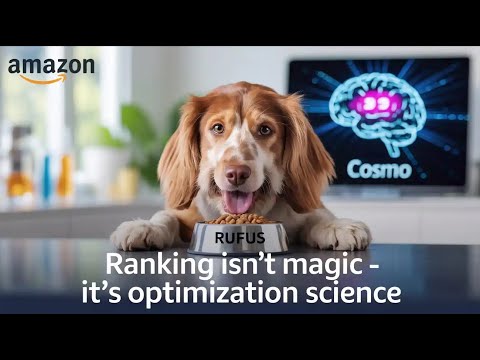
«Ranking isn't magic. It's optimization science.»
— 00:21
«If you're not aligned with Cosmo, you're invisible.»
— 11:20
«What worked in 2022, 23, 24 does not work in 2025.»
— 11:52
«It's less about gaming the algorithm and more about relevance in real time.»
— 13:45
«Keywords aren't dead, but context is king.»
— 15:53
«The one click off a zero zero search click is worth more than like 20 clicks a lot of times off of a standard listing of blue links on Google.»
— 24:51
«The forecast for agentic shopping by 2030 is almost 9 trillion with a T.»
— 25:32
«The content right now is king. Content is super value and data is super value. The people that own the data and the people that own the traffic own the market.»
— 27:21
«Ranking isn't magic. Let's be clear. It's science.»
— 31:22
«Click-through rate is a primary ranking factor when it comes to Amazon.»
— 32:28
«Remember for those of you who still don't believe that Amazon can see your images and read your images, the answer is yes. They do have OCRs.»
— 40:31
«about 75% of the shoppers come from mobile.»
— 48:16
«common sense may not always be that straightforward. And that's true. That is why the secret comes from looking and making sure that you optimize with the 15 relations that Cosmo has in mind.»
— 52:05
«This is my guess and I could be totally wrong... my guess is that Amazon's going to go the way of Facebook and TikTok.»
— 76:33
«Getting almost 10 hours from Wana for Wana's time for $200 is a steal.»
— 98:51
«customers do not buy uh products because of I don't know tech features, right?... Nobody cares about how many decibels my earpods block specifically. They want... to make sure that I don't hear my kid going crazy in the room uh next door.»
— 100:48
Reception
Comments are mostly positive and curious, with polite appreciation and interest in the product but no strong enthusiasm or criticism.
The webinar blends a genuine, moderately detailed teaching core -- RICE prioritization, Cosmo's 15-relation schema, and bot-driven image/title testing SOPs -- with heavy promotion of paid Billion Dollar Sellers products, events, and a $199 five-day training, and its more sweeping claims (agentic-commerce market size, PPC's future, Amazon's roadmap) are presented as speculation or secondhand reporting rather than confirmed Amazon data.
102:18