11:53
supplements
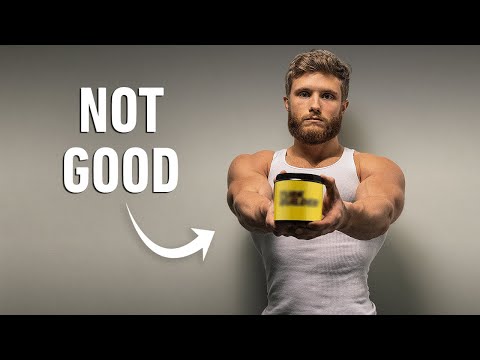
Jeff Nippard argues that five widely-used supplement categories — testosterone boosters, turkesterone, BCAAs, fat burners, and beta-alanine (for standard hypertrophy training) — remain extremely popular despite a severe lack of scientific evidence for muscle growth or fat loss, and that lifters are better served by basics (sleep, total protein, training consistency) and a 'late adopter' stance toward unproven new products.
A 2020 study analyzed the five best-selling testosterone boosters on Amazon; three of five didn't disclose individual ingredient doses (proprietary blends), and of the disclosed ingredients (horny goat weed, boron, ashwagandha, fenugreek, etc.), half had zero positive human studies.
Saw palmetto and boron each have 2 positive studies but 6 studies showing no effect; fenugreek has 4 positive but 3 indeterminate studies, leading Examine's database to conclude evidence leans against a testosterone increase.
Ashwagandha is the ingredient Nippard finds most promising (he takes 600mg/day, primarily for cortisol/stress reasons) but injected testosterone raised levels by 1740 ng/dL vs. ashwagandha's 96 ng/dL — a comparison that puts natural boosters in perspective.
Better, non-supplement ways to raise testosterone: 7-8 hours of sleep, maintaining a healthy body weight, sufficient dietary fat, and correcting deficiencies in zinc, magnesium, or vitamin D.
Despite weak evidence, the top five Amazon test boosters averaged 4.5/5 stars — Nippard attributes this to placebo and to buyers simultaneously changing training/diet and misattributing results to the pill.
Turkesterone has zero human studies. The closest evidence is a 2019 Eisenmenger study on a related ecdysteroid showing muscle gains vs. placebo — but lab testing found the pills contained only 6% of the ecdysterone claimed on the label.
Independent lab tests by Nootropics Depot found Greg Doucette's 'Turk Builder' contained just 0.15% of its labeled turkesterone dose (0.7mg vs. 5,100mg claimed), Gorilla Mind's product had less than 1%, and some other turkesterone products had none detectable.
Nippard flags a potential conflict of interest (Nootropics Depot also sells supplements) but, citing his biochemistry degree, finds their chemistry credible while admitting his own anti-turkesterone bias.
General principle (citing Dr. Eric Helms): even the most effective supplements like creatine and caffeine have only a small impact, so it's safe to be a 'late adopter' and wait a year or two on unproven new products in a poorly regulated industry.
BCAA = branched-chain amino acid; of the 9 essential amino acids, 3 (leucine, isoleucine, valine) are branched-chain. Leucine triggers muscle protein synthesis (MPS) but isoleucine/valine don't — they're included because isolated leucine depletes blood levels of the other two.
Even with all three BCAAs present, muscle building requires all 9 essential amino acids, so BCAAs alone are functionally useless — like turning a car key with no gas in the tank.
A January 2022 systematic review of 12 studies found no benefit of BCAA supplementation on performance, strength, or muscle mass.
Possible EAA (essential amino acid) supplement use cases: boosting a low-protein-quality vegetarian meal, or as 'anabolic insurance' during fasted training near the end of a diet — otherwise just eat enough total protein.
Fat burners claim to work via appetite suppression (fewer calories in) or thermogenesis (more calories out); a recent meta-analysis found no added benefit over exercise or diet-plus-exercise alone.
Caffeine and green tea extract do have a real, measurable thermogenic effect, but it's small relative to diet and exercise; caffeine is still worth taking pre-training for performance, not fat loss, and Nippard is skeptical when it's repackaged with other unproven ingredients as a 'fat burner.'
Beta-alanine genuinely works — it buffers muscle acidity — but only for efforts lasting roughly 1-4 minutes; a 2012 meta-analysis found no effect for exercise under 60 seconds, meaning it doesn't help typical 6-15 rep hypertrophy sets, though it may help endurance training or high-rep circuit work.
Testosterone boosters (OTC blends) — Over-the-counter supplement blends (horny goat weed, boron, ashwagandha, fenugreek, etc.) marketed to raise testosterone, most with weak or absent human evidence per the 2020 Amazon-product study. Apply: Per Nippard, skip most test boosters; ashwagandha (he takes 600mg/day) is the one ingredient worth considering, mainly for its cortisol/stress benefits with a possible small testosterone bonus.
Turkesterone / ecdysterone (ecdysteroids) — Plant-derived steroid-like compounds marketed for muscle growth; turkesterone itself has zero human studies, and related ecdysterone products tested by independent labs were found massively underdosed (as low as 0.15% of label claim). Apply: Be a 'late adopter' — avoid buying turkesterone products until quality-controlled human evidence and reliable dosing exist, waiting a year or two as the industry catches up.
BCAA (branched-chain amino acids: leucine, isoleucine, valine) — Three of the nine essential amino acids; leucine alone triggers muscle protein synthesis but the full set of nine essential amino acids is required to actually build muscle tissue. Apply: Skip standalone BCAA supplements — a January 2022 review of 12 studies found no strength/mass/performance benefit — and instead focus on hitting total daily protein intake.
EAA (essential amino acid) supplementation — Supplementing all nine essential amino acids together, rather than just the three branched-chain ones. Apply: Consider EAAs only in narrow cases: to boost a low-protein-quality vegetarian meal (or use a vegan protein shake instead), or as 'anabolic insurance' sipped during fasted training near the end of a diet.
Fat burners / thermogenic supplements — Products claiming to aid fat loss either by lowering appetite (fewer calories in) or increasing energy expenditure via thermogenesis (more calories out). Apply: Don't rely on branded 'fat burner' blends — meta-analyses show no added effect beyond diet and exercise; take caffeine on its own before training for performance benefits, and be skeptical of caffeine repackaged with unproven herbs as a fat burner.
Beta-alanine — A compound that buffers muscle acidity, extending time-to-fatigue specifically for continuous efforts lasting roughly 1 to 4 minutes, per a 2012 meta-analysis. Apply: Use it for endurance training, high-rep sets, or circuit-style workouts with a cardio component; don't expect a benefit for typical 6-15 rep hypertrophy training, where the set is too short for acidity to matter.
Nippard explicitly flags a methodological weakness in his own analysis: simply tallying 'studies for vs. against' a supplement ignores study quality, but he argues it's still useful for a general lay of the land.
The 1740 ng/dL (injected testosterone) vs. 96 ng/dL (ashwagandha) comparison isn't just a data point — it's used rhetorically to recalibrate expectations for what a 'promising' natural test booster can actually do.
The turkesterone case links two separate scandals (the 2019 Eisenmenger ecdysterone underdosing and the 2022 Nootropics Depot lab tests) to build a cumulative case that the entire ecdysteroid category has a quality-control, not just an efficacy, problem.
Nippard turns a potential bias objection (Nootropics Depot sells competing supplements) into a credibility argument by applying his own biochemistry background to assess the chemistry, while transparently naming his own bias too.
The BCAA 'key without gas' analogy is used to explain why leucine can technically 'work' (trigger MPS) while the supplement as a whole is still functionally useless without the remaining essential amino acids.
Amazon's 4.5-star average rating for the test boosters is used as evidence *against* efficacy — Nippard reframes positive reviews as a placebo/confound signal rather than proof of a product working.
The beta-alanine verdict isn't a blanket dismissal — Nippard isolates the exact training duration window (1-4 minutes) where it works, which excludes typical hypertrophy rep ranges but includes endurance and circuit training.
«although there is limited evidence to support an increase in testosterone more evidence than not deny such an increase»
— 01:23
«ashwagandha only increased testosterone by 96 nanograms per deciliter so pretty underwhelming by comparison to actual steroids»
— 02:33
«if you have fairly normal or even high testosterone levels none of the supplements currently marketed as testosterone boosters are likely to yield meaningful benefits»
— 03:09
«it only actually contained 0.7 milligrams per capsule just 0.15 percent of what was advertised on the label was actually in the bottle»
— 05:02
«even the most effective supplements like creatine and caffeine still make a very small impact»
— 06:30
«you can think of it like the key to starting your car»
— 07:39
«there was no indication that the inclusion of fat burners and thermogenic dietary supplements was any more effective than exercise or a combination of diet and exercise»
— 09:39
«this 2012 meta-analysis found that beta alanine was only effective for exercise lasting one to four minutes and didn't do anything for exercise lasting less than 60 seconds»
— 10:53
Reception
Genuinely positive reception with thoughtful supplement discussion and personal success stories, but undermined by apparent coordinated fake testimonials for an illegal vendor.
The video is a tightly organized, evidence-citing debunking piece that pairs each supplement's negative verdict with a concrete alternative (sleep and micronutrients over test boosters, total protein over BCAAs, caffeine over fat-burner blends, endurance training over beta-alanine for lifters), rather than a blanket 'supplements don't work' dismissal.
11:53