79:24
AI agents/loops
AI amplifies human agency rather than creating a 'permanent underclass': companies and individuals are moving toward cascading 'loops' (agents that handle verifiable, bounded-upside work) while humans remain essential for out-of-distribution ideas, ambition-setting, and unverifiable high-touch work — and the biggest unclaimed opportunity is not productivity but product design for human connection and happiness.
The 'permanent underclass' fear is dismissed as a 'dark fantasy' unsupported by evidence: opportunity is unusually distributed, roughly 20 competitors exist at every layer of the AI stack instead of one winner, and job postings for supposedly 'cooked' professions like radiologists remain high.
Fast-takeoff/RSI fears are rejected in favor of 'autocatalytic effects' (using new tech to improve process, not true recursive self-improvement), and economic diffusion of AI into daily life is argued to be much slower than model progress, which will blunt any runaway effect.
Many problems are argued not to be 'intelligence bound' (e.g., a data center of PhDs wouldn't dominate pizza supply chains), so most industries' competitive equilibria are predicted to survive AI largely intact, with winners determined mainly by adoption speed and ambition rather than a single company capturing a market.
Company-building is framed as evolving from prompts to agents to cascading 'loops' — from a loop per person up through job functions, business units, and eventually large parts of a company — but loops climb to a local maxima and plateau, requiring human intuition to find the next hill to climb.
Choosing model tiers is framed as a Pareto-efficiency economic decision: functions with bounded upside (e.g., closing the books) should use cheap, RL-tuned mid-IQ open-weight models, while functions with unbounded upside (sales, research, drug discovery) justify frontier-model cost — complicated by the fact that upside itself is hard to calculate in advance (e.g., a support call could be the first thread to a company-changing insight).
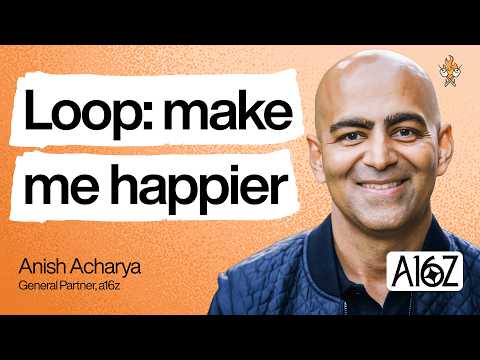
The real bottleneck for consumer AI is argued to be product design, not model capability: people want to spend time, not just save it, so the underserved opportunity is a 'loop, make me happier' — AI addressing connection, loneliness, and fun rather than only productivity, held back historically by model cost, a chat-vs-TikTok interface gap, and an industry bias toward productivity tools.
As loops absorb routine execution, human differentiation shifts toward the scale of ambition (business, creative, and civic); this is described as reshaping a16z's own investment criteria, which used to reject overly ambitious pitches and now avoids ideas that are too small.
Business moats are argued to be 'discovered, not designed' through shipping and customer feedback rather than engineered upfront (Cursor and Granola cited as examples); classic moats (network effects, scale, brand, data) still work but require founder ambition, and distribution is reframed as the new critical moat since organic word-of-mouth has replaced growth-hacking-era network capture.
Consumer software pricing norms are described as inverting: instead of assuming consumer products must be free, the source argues for building deliberately expensive consumer products (a 'software Birkin bag') since price now functions as a signal of product-market fit.
Practical personal advice is offered for coping with AI-era anxiety: adopt an 'AI-first' reflex before doing tasks, maintain an ongoing low-stakes personal project ('chassis') to build model intuition by shipping weekly, and note that skeptics typically convert once they experience a genuine moment of joy from something AI made for them.
Loops (cascading agent loops) — A progression from a loop automating one person's work up through job functions, business units, and eventually large parts of a company. Apply: Identify a repetitive, verifiable task, wrap it in an agent loop with tools/memory, then chain loops upward from individual to team to org level as each layer proves reliable.
Prompts → Agents → Loops progression — A maturity model where single prompts evolve into agents (model + tools + memory + skill files) and then into loops (sets of agents performing ongoing tasks). Apply: Start by giving a model tools and memory to make it an agent, then compose multiple agents into a running loop that handles a full task end-to-end.
Coding bug-fix loop pipeline — A concrete engineering loop: bug report → repro generation → fix creation → automated review → risk-based gate (human confirmation for high risk, auto-ship for low risk) → customer notification, in about five minutes. Apply: Automate the repetitive steps of bug triage and fixing, but insert a human confirmation gate specifically for high-risk changes before they ship to production.
Business loops / GM aggregation with CEO escalation — A framework where a general manager oversees the aggregate output of several functional loops (coding, marketing, sales, support, legal), with a 'strong form' where the system escalates to the CEO when a strategic or business-model change is needed. Apply: Have loop outputs across functions report into a manager who optimizes their combined performance, and set thresholds where anomalies get escalated up to leadership.
Growth-team experimentation loop — An automated replacement for manual growth experimentation: auto-generate variants, auto-measure results, gate on statistical significance, auto-merge/ship the winner, keep a long-term holdout, and move to the next experiment. Apply: Replace spreadsheet-and-meeting growth experiment cycles with an automated pipeline that generates, measures, and ships winning variants without manual intervention.
Hill-climbing to local maxima model — A conceptual model where a loop optimizes a system up to a local maximum and then plateaus, requiring human intuition to identify the next 'hill' worth climbing. Apply: When a loop's metric growth stalls, treat that as a signal to stop optimizing further and instead have a human propose a new direction or strategy shift.
RSI vs. autocatalytic effects — A distinction between true recursive self-improvement (a runaway feedback loop) and 'autocatalytic effects,' where new technology merely helps improve an existing process incrementally. Apply: Use this distinction to evaluate claims of runaway AI capability gains — check whether reported gains are process improvements (autocatalytic) rather than genuine self-improving recursion.
Electricity-diffusion analogy — A historical analogy noting it took roughly 40 years from electricity's invention for factories to be reorganized around it, rather than just swapping power sources. Apply: When adopting AI, distinguish between simply plugging AI into existing workflows versus rebuilding the organization's structure around it, expecting the latter to take much longer.
Kavak's 'Jedi Academy' — An internal company training program where employees, including mechanics, complete a six-week course culminating in shipping a production AI agent. Apply: Run a time-boxed, hands-on internal training program that ends with every employee shipping a real, in-production AI tool rather than just learning theory.
'What do you know that it doesn't know?' diagnostic — A heuristic for debugging agent mistakes by framing every failure as either a knowledge gap or a data gap relative to the human. Apply: When an agent errs, ask what specific knowledge or data the human has access to that the agent lacked, then feed that back into the agent's context or training.
Kavak's agent-per-customer escalation model — A support model where each customer has a dedicated agent that calls a human when stuck, and the resulting interaction is captured so the agent learns and avoids repeating the escalation. Apply: Design agents to escalate to a human on failure, then log and feed the resolution back into the agent so the same gap doesn't recur.
Infinite-intelligence reorg heuristic — A founder/CEO thought experiment: assume AI becomes infinitely intelligent and astonishingly cheap, then ask how the company would need to be restructured. Apply: Periodically ask leadership to redesign the org chart and workflows as if intelligence were free and unlimited, to reveal where current structure is a legacy constraint.
Pareto efficiency for model price/performance — Applying the economic concept of an efficient frontier to AI model selection — the optimal tradeoff of performance per unit of price. Apply: For a given task, plot available models on price vs. performance and choose ones on the efficient frontier rather than defaulting to the most expensive frontier model.
Open-weight vs. frontier model split — A framework splitting AI usage by function: cheap, RL-tuned open-weight models for bounded-upside, mid-IQ tasks, and expensive frontier models for high-upside functions like sales, support, research, and engineering. Apply: Audit each business function's upside ceiling, then route bounded-upside functions to cheaper fine-tuned open-weight models and reserve frontier-model spend for functions with large potential payoff.
Upside-magnitude × calculability heuristic — A refinement arguing that model-tier choice should depend on both how large a task's potential upside is and how hard that upside is to foresee in advance — not on verifiability alone. Apply: Before defaulting a function to a cheap model, ask whether a seemingly low-stakes interaction (like a support call) could plausibly be the first thread to a much larger discovery, and if so, route it to a stronger model.
'Model sommelier' method — An approach to building intuition about different AI models by extensively using and shipping something with every new model release, likened to a wine sommelier's practice. Apply: Commit to trying and shipping a small project with each newly released model rather than assuming models are interchangeable commodities.
Multi-model creative pipeline — A demonstrated pipeline combining a long-horizon creative/orchestration model (Qwen) with a video-generation model (MiniMax) and an audio-generation service (ElevenLabs) to produce a short 'documentary.'. Apply: Assign each model in a pipeline to the task it's specifically strong at (scripting/direction, video, audio) and let one model act as 'director' reviewing and assembling the outputs.
'Chassis' project method — Maintaining an ongoing, low-stakes personal or side project as a stable base to repeatedly apply and test new AI models against, rather than ideating from scratch each time. Apply: Pick one non-critical ongoing project and keep applying each new model release to it to build practical intuition over time.
'How can AI do this for me?' habit — A proposed reflex to insert into the gap between encountering a task and acting on it, analogous to the meditative gap between stimulus and response. Apply: Before starting any task, pause and explicitly ask whether an AI tool could do it instead, before defaulting to doing it manually.
Revealed vs. stated preferences — A framework distinguishing what people actually do (e.g., use ChatGPT daily) from what they say they believe or want societally (e.g., oppose AI data centers nearby). Apply: When interpreting public opinion on AI, separate individual behavioral data from surveyed or stated attitudes, since the two can diverge sharply.
'Too dangerous to release' critique — A skeptical framework arguing that claims a model is too dangerous to release may conflate marketing value, GPU/inference capacity limits, and the economic incentive to keep a competitive edge proprietary. Apply: When a lab claims a model is withheld for safety, check for alternative explanations like compute constraints or competitive strategy before accepting the safety framing at face value.
Dario/Amodei vs. David Sacks spectrum — A framing device placing AI-jobs predictions on a spectrum from Dario Amodei's pessimistic ~50% knowledge-work disruption to David Sacks's optimistic 'jobs will be fine' view. Apply: Use this spectrum to locate and communicate where a given prediction or personal stance falls on AI's labor-market impact.
Claude Code team's delegation principle — An internal team habit of asking 'what's better than me doing it? It's Claude doing it' to prompt delegation of tasks to the AI. Apply: Adopt a team norm of explicitly asking before any task whether the AI agent could do it better or faster, and defaulting to delegation when so.
'Moats are discovered, not designed' — A product-strategy heuristic (attributed to Jesse from Decagon) that durable competitive advantages typically emerge from shipping and iterating rather than being planned upfront. Apply: Avoid over-engineering a moat narrative before launch; ship a strong product first and let proprietary data, brand, or network effects emerge from real usage.
'Software Birkin bag' pricing exercise — A thought experiment for premium product design: imagine a $10,000/month or $1,000/month version of your product and reverse-engineer what it would need to do to justify that price. Apply: When designing a product, explicitly ask what features or positioning would be required to sell it at a dramatically higher price point, then work backward from that answer.
'Come for the tool, stay for the network' reexamined — Chris Dixon's classic bootstrapping framework for building networks, revisited with the observation that today's existing networks are defensively structured to prevent others from building on top of them. Apply: When planning network-effect growth strategy, account for major platforms actively blocking third parties from piggybacking on their networks, and favor organic word-of-mouth channels instead.
Nikhil's 'moment of joy' adoption framework — An observation that AI skeptics typically convert once they personally experience a moment of genuine joy created by AI (e.g., a Codex-built Mother's Day slideshow). Apply: To get a hesitant person to embrace AI tools, help them build one small, personally meaningful project (for themselves or someone they care about) rather than pitching abstract capability.
Ship-weekly practice — A heuristic of shipping some small AI-built project once a week, regardless of significance, to build hands-on model fluency. Apply: Set a personal cadence of releasing one small built thing per week using current AI tools, without requiring it to be important or polished.
The source argues people systematically underestimate the 'average employee,' pointing to grassroots AI adoption even at non-tech companies like Kavak, whose 'Jedi Academy' trains mechanics and other staff to ship production AI agents within six weeks.
Executive incentives are cited to explain why AI-driven layoffs haven't materialized as feared: a company like Google wants to become a $40 trillion company, not a leaner $4 trillion one, so a Google executive reportedly reports zero AI-related layoffs and instead an accelerated roadmap (two years of work now happening in three months).
Skills long dismissed as 'soft' because they lack clear success criteria are argued to be exactly the skills resistant to being turned into a loop, inverting the old status hierarchy that favored concrete, verifiable engineering skill.
The 'model too dangerous to release' narrative is treated skeptically as possibly conflating marketing, GPU/inference capacity constraints, and the economic incentive to keep a proprietary model's edge internal rather than reflecting genuine danger.
AI's legitimacy problem, in this account, is best solved not through better messaging but by making 'important things' — healthcare (45% administrative overhead) and education — radically cheaper.
Public dissonance about AI (individuals enthusiastically using ChatGPT while communities oppose nearby data centers) is explained through a revealed-preferences vs. stated-preferences framework.
Financial products are described as inherently social but built 'dry, personal, and embarrassing' — illustrated by MSCHF's viral 'Card vs Card' debit-card stunt — framed as an underexploited design space now reachable with AI.
A personal anecdote about rigging a kitchen microphone to reward/punish a child's screen time based on detected prosocial speech, and the child gaming it by looping a recording of himself saying 'I love you, Dad' next to the mic, is used to illustrate how quickly any measured proxy gets gamed.
The claim that 'every network today is hyper-trained to ensure no one else builds a network on their network' is used to argue that Chris Dixon's 'come for the tool, stay for the network' playbook no longer works the way it did for prior platform-era startups.
The current openness of consumers and enterprises to pay for AI products at high, sometimes poorly-understood prices (e.g., $200/month personal plans, million-dollar ACV contracts) is compared to the 'Christmas 2009' iPhone app boom — described as a temporary window that favors startups before it closes.
«It's a funny dark fantasy that we seem to have as Silicon Valley collectively.»
— 00:09
«In the old days, 3 years ago, we would see a company and if what they were trying to do was too ambitious, we would, you know, not engage. Today, we're almost seeing the opposite problem. An idea that's too small is not something that we want to engage with.»
— 00:27
«The loop will help you climb to the local maxima, but then it plateaus. You need human intuition. You need somebody to actually help you land at the base of the next hill.»
— 00:54
«We believe that people want to be more productive, but they don't. I think more people want to spend time than save time.»
— 01:07
«I don't think it's a model or a capability challenge. It's just a product design challenge.»
— 01:22
«It's autocatalytic effects, which just means you're using the new technology to improve your process, but it's not truly recursive.»
— 04:53
«The line of reasoning for that case is always everything up until now, then something happens that no one can quite articulate and then fast take off.»
— 06:06
«If you had a data center of PhDs working at FedEx or Domino's Pizza, are they going to be like exponentially dominating supply chain and pizzas? Like I don't think so.»
— 06:34
«It took 40 years for us to get from the inception of electricity to reorganizing factories.»
— 09:29
«He doesn't want to run a more efficient $4 trillion company. He wants to build a $40 trillion company.»
— 10:15
«Hey Claude, make me a million dollars, make no mistakes. Like, why doesn't that work, you know?»
— 15:54
«if we assume these things are infinitely um intelligent and astonishingly cheap, how would we reorganize the company?»
— 21:28
«When the stakes are high, we are awesome. When the stakes are low, we are at our absolute worst.»
— 38:20
«The most important thing that we can do with AI to change the kind of conversation around it is make important things cheap.»
— 40:36
«Moats are most often discovered, not designed.»
— 54:54
«Nobody has a growth problem these days, they have a product problem.»
— 61:26
«What if our product was a software Birkin bag? What would it have to do to justify that?»
— 61:52
«Money is inherently social and yet all the financial products we have are so dry and personal and embarrassing.»
— 64:16
«the music industry is going to be bigger than it's ever been.»
— 78:14
Reception
Most commenters praised the episode as thoughtful and refreshing, with only a handful pushing back as overly optimistic or disconnected from reality.
A wide-ranging, framework-heavy VC conversation that reframes AI-era anxiety through a consistent optimistic lens (loops, Pareto pricing, ambition-as-differentiator) and offers concrete product heuristics, but its claims rest largely on a16z portfolio anecdotes and the guest's personal experience rather than independent data.
79:24